
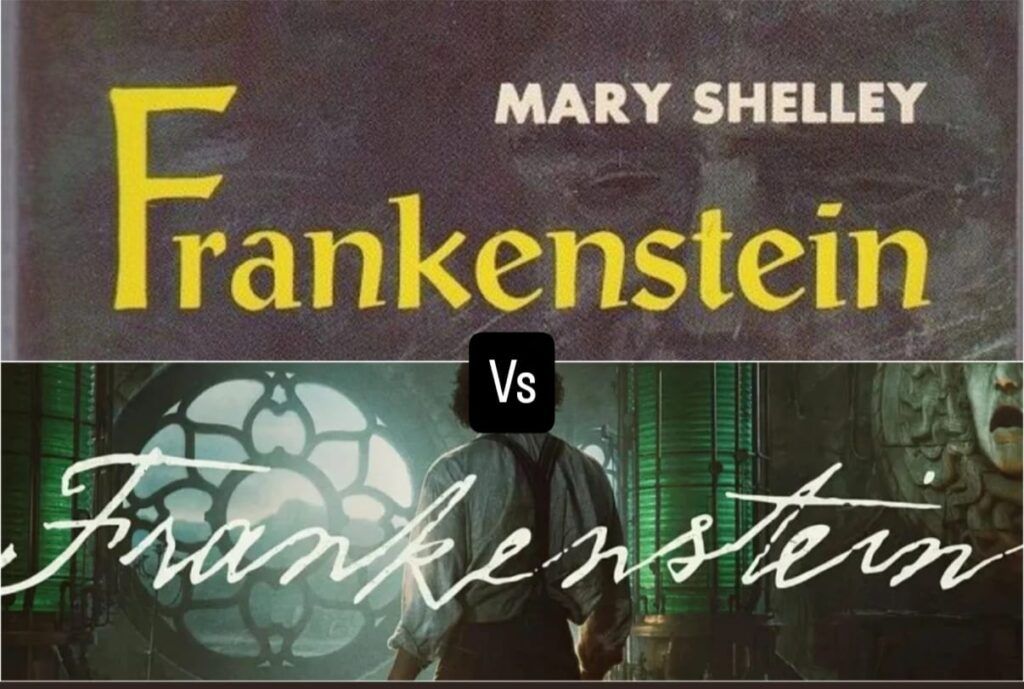

I went into Guillermo del Toro’s Frankenstein (2025) knowing one thing clearly: this was never going to be Mary Shelley’s Frankenstein as I first met it on the page. And honestly, I didn’t want it to be.
If you’ve read the novel—or even carried it with you for years—you’ll feel the difference immediately. Del Toro doesn’t retell Shelley’s gothic warning about ambition. He listens to it, holds it gently, and then asks a quieter question: What if this story was really about grief, about damaged love, about a child who was never taught how to be loved?
That shift changes everything.
In Shelley’s novel, Victor Frankenstein grows up surrounded by warmth and care. In the film, I meet a Victor who has never known emotional safety. His father is distant, cruel, and abusive, and his mother’s death leaves a wound that never closes. I don’t see ambition driving him anymore—I see a man trying desperately to undo loss, trying to outrun grief by conquering death itself.
This Victor is also older. He isn’t a reckless student chasing ideas; he’s a broken surgeon shaped by war and failure. The Crimean War setting matters. Bodies are no longer theoretical—they are casualties. Creation here feels less like hubris and more like a moral injury that keeps deepening.
Elizabeth, too, feels different this time. I’m not watching a fragile ideal waiting to be sacrificed. She thinks, questions, pushes back. She has her own inner world, and that alone changes the emotional gravity of the story.
But the biggest shift—for me—comes with the Creature.
In the novel, the Creature frightens me because of how deliberate his cruelty becomes. In del Toro’s version, he frightens me because of how innocent he is. I don’t see a monster plotting revenge. I see a child trapped in a body too strong for his own fear. His violence doesn’t come from hatred; it comes from panic, confusion, and being hurt first.
Even Victor’s response to him is altered. Shelley’s Victor runs away the moment life appears. Del Toro’s Victor stays. He tries. He fails. And when he becomes abusive, it hurts more—because I can see how his own upbringing is repeating itself, cycle after cycle.
The film removes many familiar characters and storylines, including the female companion. Instead of repeating the tragedy of another abandoned creation, del Toro offers something softer and riskier: connection. Imperfect, fragile, human connection.
And when death comes—as it inevitably does—it doesn’t feel vengeful anymore. It feels accidental, desperate, unbearably human. No one wins. No one feels satisfied. Only broken.
By the time the story reaches its end, I realize this Frankenstein isn’t asking me to judge. It’s asking me to listen.
Where Shelley leaves us in ice and unresolved hatred, del Toro leaves space for reconciliation. When Victor finally calls the Creature “son,” it doesn’t erase the harm—but it names it. And when the Creature chooses life instead of destruction, it feels like an act of quiet rebellion against everything he was taught to become.
So I didn’t walk away thinking this was a replacement for Shelley. It isn’t.
I walked away thinking this was a conversation with her—one that believes even after abandonment, even after cruelty, something human can still survive.